Uploading Models
To upload models, you will need to create an account at CSGHub. Models are Git-based repositories, which give you versioning, branches, discoverability and sharing features. You can upload anything you want to the model repository, including model files, configuration files, and any other files.
Currently, we support four ways to upload files: via Web interface, Git, Command Line (CLI), and SDK.
💡 Which method should I choose?
- Web interface: Suitable for small files; check the current upload page and deployment configuration for the per-file limit.
- Git: Suitable for version control and managing a large number of scattered code and configuration files.
- Git/CLI: Use Git LFS for large Git files, or the repository-type-specific CLI instructions where provided. Limits depend on the site and storage configuration.
Upload Files to a Repository Using Git
Prerequisites
git config --global user.name "Your name"
git config --global user.email "you@example.com"
- Obtain an Access Token from Account settings → Access Token on the target deployment. Use it as the password when HTTPS Git requests credentials. Organization repositories also require write permission.
Upload Steps
Copy the HTTPS clone URL from the current repository. Replace the sample namespace and repository; use your deployment's actual address.
git lfs install
git clone https://your-csghub.example.com/models/your-namespace/example-model.git
cd example-model
Copy the intended files into the local repository. Check that no credentials or unintended files are included, then commit and push:
git add .
git commit -m "Upload repository files"
git push
Verify the files and commit in the target repository's Files tab.
[Note]
Use Git LFS for large files. Before git add, check the repository's .gitattributes. Add a tracking rule if required:
git lfs track "path/to/large-file"
git add .gitattributes
File size and timeout limits depend on site, proxy and storage configuration. Preserve the file size and error, and use a supported workflow described on this page. Site limits are not a universal Git LFS protocol limit.
Managing and Uploading Files via Web Interface
In the repository's Files tab, select Add file, then choose New folder, Create new file, or Upload file.
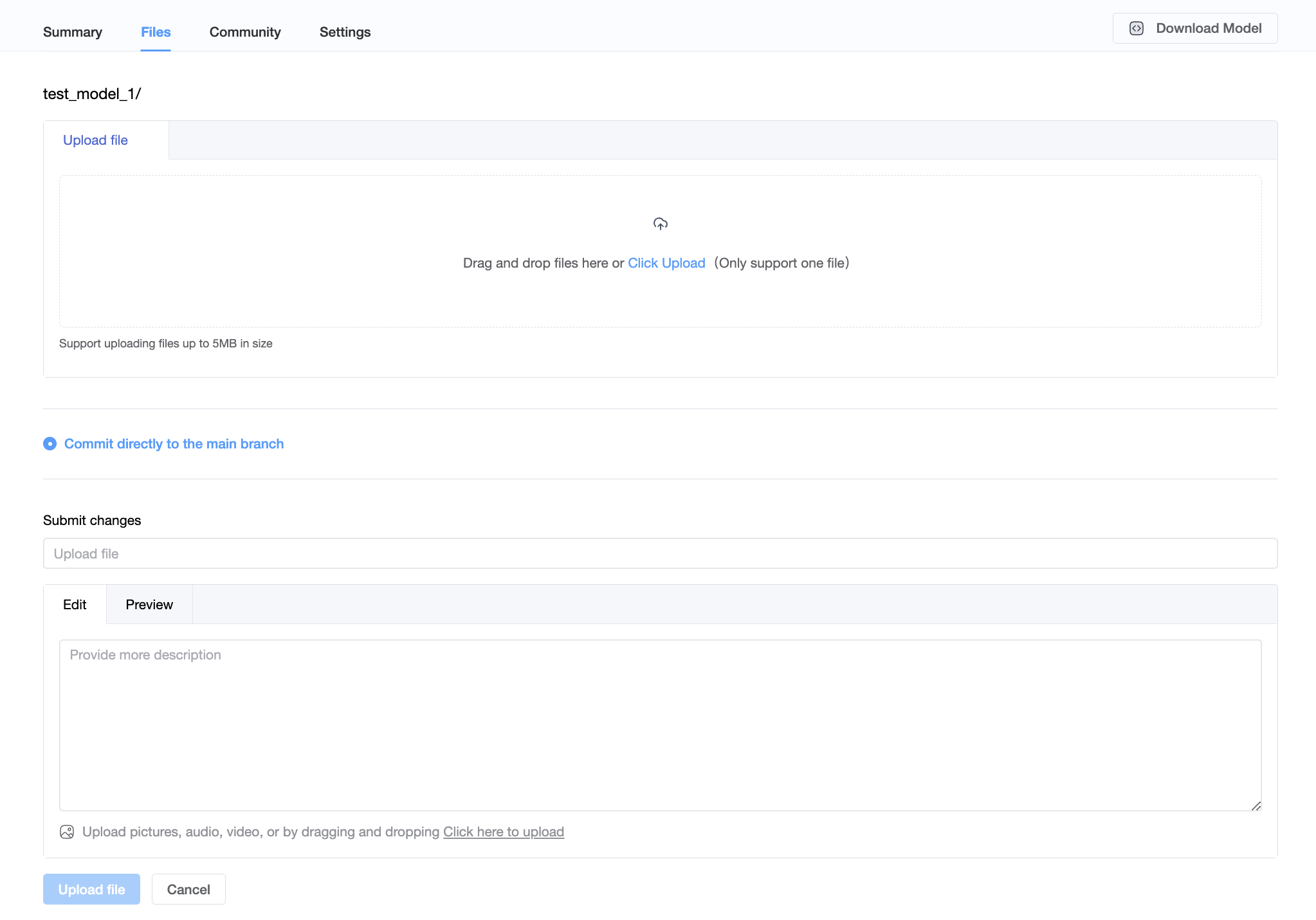
The per-file limit is defined by the current upload page. For larger files, use a transfer method documented as supported on this page.

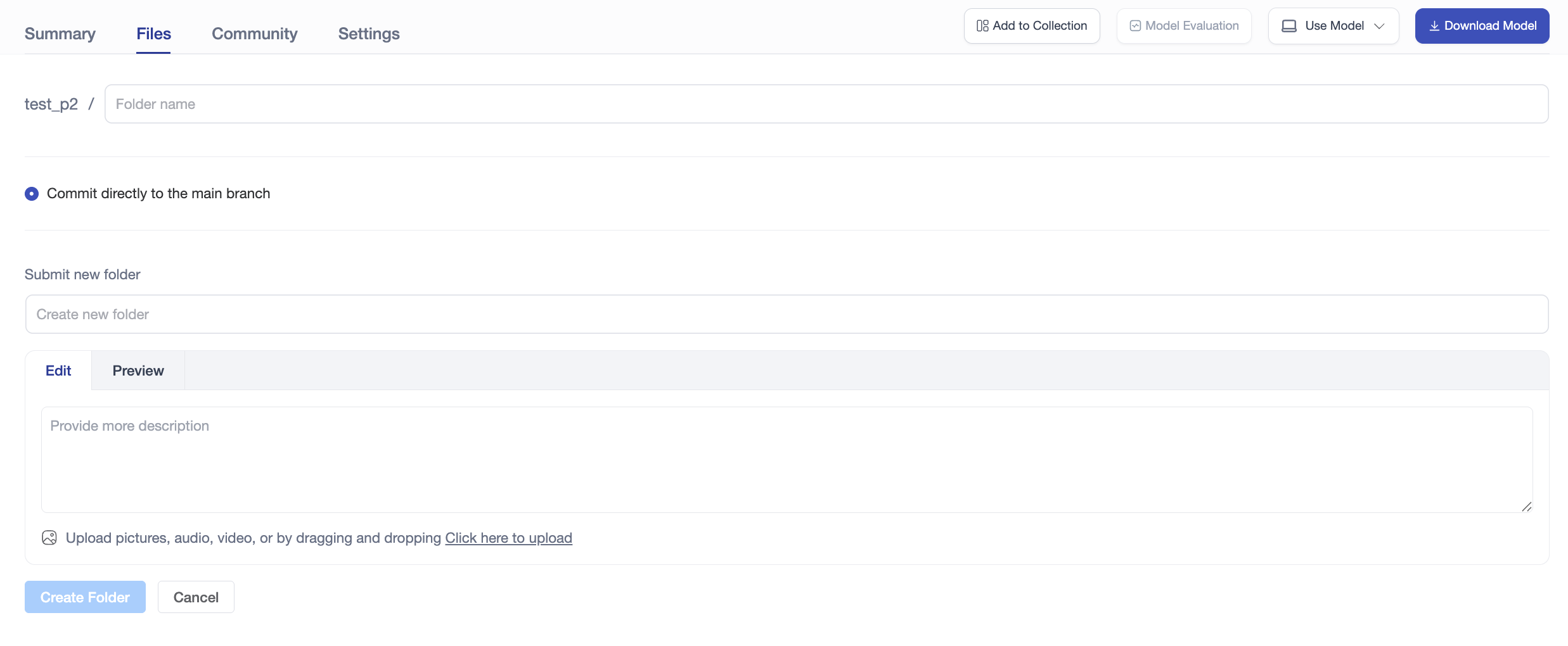
Creating a New Directory
Select New folder, enter a name and submit to create a subfolder under the current repository path.
Creating a New File
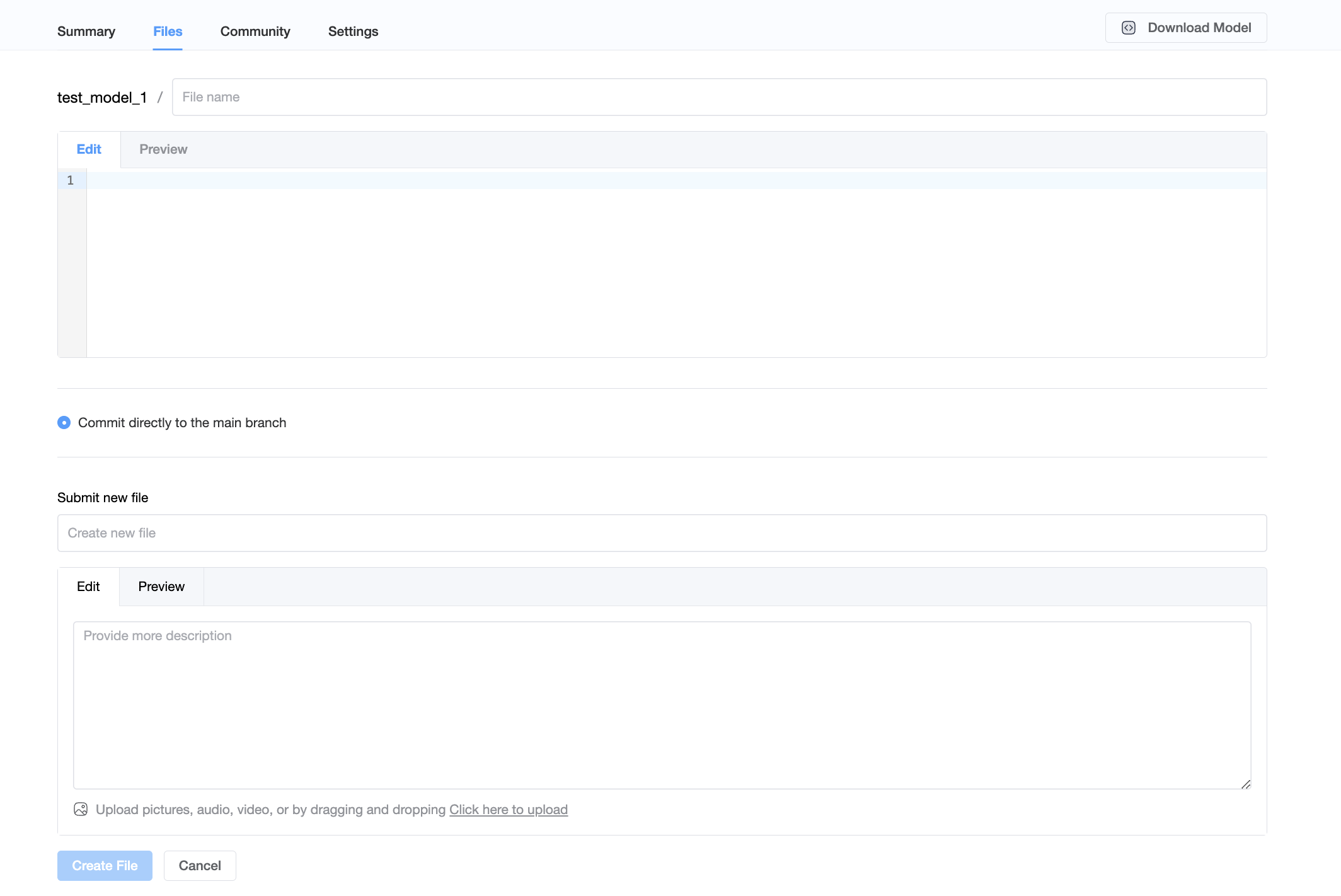
Select Create new file, enter the file name and content, then select Create File to save and commit it.
Uploading a File
Select Upload file, choose the local file and submit. Confirm that it appears in the repository file list after the upload completes.
Upload with the CLI
Create the target repository first and confirm write access. Install a compatible csghub-sdk and inspect csghub-cli upload-large-folder --help. Configure this site's CSGHUB_TOKEN in the runtime. Replace the endpoint, repository ID and local directory; the platform API URL is not the inference gateway URL.
export CSGHUB_ENDPOINT="https://your-csghub.example.com"
csghub-cli upload-large-folder your-namespace/example-model ./my_model \
  --repo-type model --endpoint "$CSGHUB_ENDPOINT"
Specify model or dataset explicitly. Preserve upload progress files until completion. If your client lacks these options, check supported versions instead of omitting endpoint or type.
Upload with the SDK
Repository uses Git and Git LFS. Reuse CSGHUB_ENDPOINT and CSGHUB_TOKEN, and set CSGHUB_USERNAME to your login account (which may differ from an organization namespace).
import os
from tempfile import TemporaryDirectory
from pycsghub.repository import Repository

with TemporaryDirectory(prefix="csghub-upload-") as work_dir:
    repo = Repository(
        repo_id="your-namespace/example-model",
        upload_path="./my_model",
        user_name=os.environ["CSGHUB_USERNAME"],
        token=os.environ["CSGHUB_TOKEN"],
        endpoint=os.environ["CSGHUB_ENDPOINT"],
        repo_type="model",
        work_dir=work_dir,
        auto_create=False,
    )
    repo.upload()
Verify
Check the files, owner and commit in the target repository, then download a copy and compare content. A completed progress indicator alone is not sufficient verification.